You need a garden water hose. . . there’s just no question about it.
Your thirsty plants need water, and you can’t be carrying a heavy bucket of water around, sloshing it all over, then dumping it all over your vulnerable plants. You can kill a plant that way, not to mention the impracticality of carrying that heavy bucket of water around.
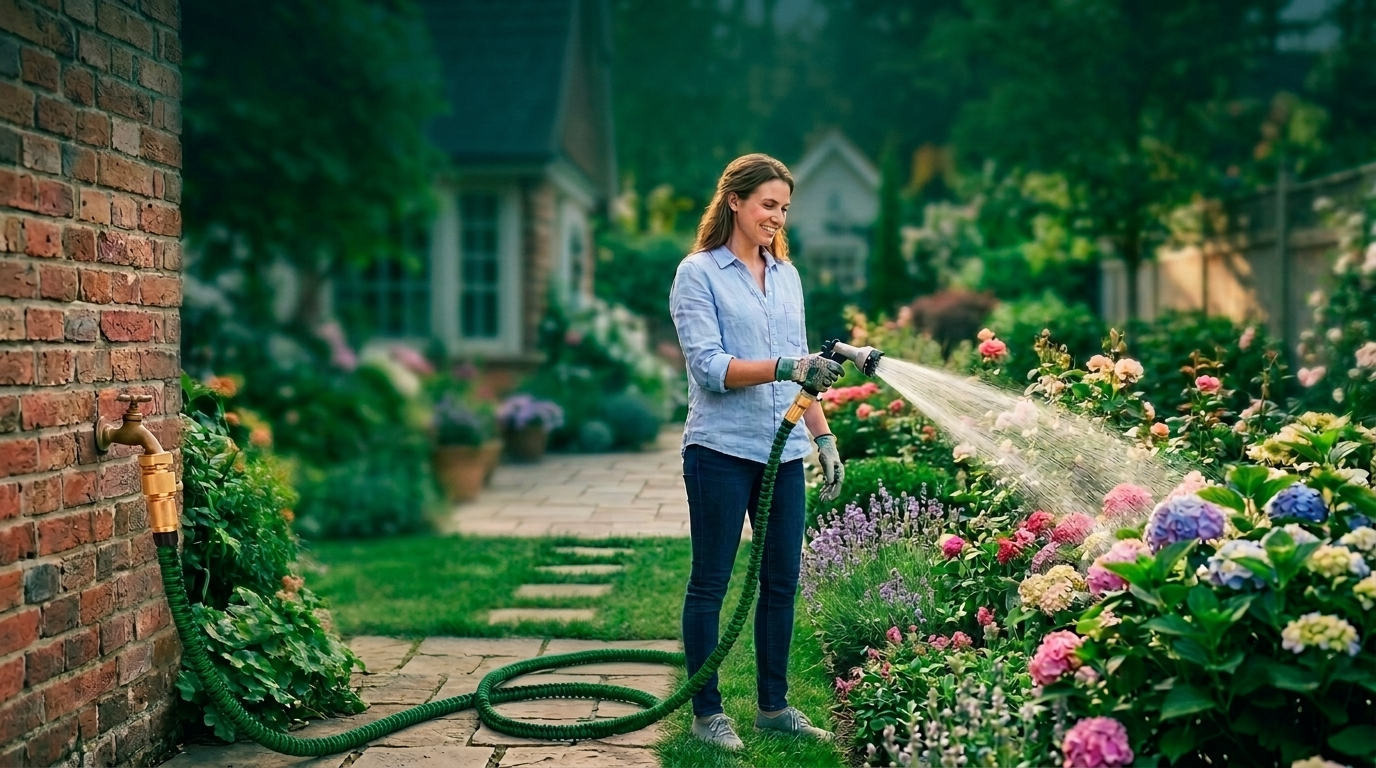
There is a better way, and that, of course, is to use a water hose. Just hook a garden hose nozzle to the end of your hose, and you’re all set.
Let’s remember that a garden hose is not just for the garden. You can use it for a ton of things, like washing the car, rinsing off muddy boots, washing the dog, filling the swimming pool, spraying down a dirty garage floor or driveway, and many other tasks that require water.
Click here to view all the safe-drinking water hoses and lead-free garden hoses at Amazon.com.
But don’t just go out and buy a hose before doing a little research. You need to consider price, materials, length, fittings, and potability of your new hose.
Click here to view all the safe-drinking water hoses and lead-free garden hoses at Amazon.com
.
Price: If you have ever struggled with a cheap hose, one that kinks every time you move it, stopping the water flow, one that’s difficult to maneuver and to coil, one that springs a leak soon after you buy it, you know that you want a good quality hose. You do get what you pay for in garden hoses. You should expect to pay about $25 to $40 for a good 50-foot length. It will last for many years with the proper care. You’ll find many hoses that carry a lifetime warranty.
Materials: A hose may be made of rubber or vinyl or a combination of the two. Good hoses will be made of multiple layers of reinforcing fabrics such as nylon or rayon. Any of these options are fine. What makes a hose more heavy-duty is whether it is reinforced. A reinforced hose will typically bend easily without kinking, have a greater burst strength, durability and lifespan.
Length: Hoses usually come in lengths of 25 feet, 50 feet, 75 feet, and 100 foot. Buy the correct length hose based on how far you need to move water. The amount of water a hose can carry depends on its size, length and available water pressure. Typical hose diameters are 1/2 inch and 5/8 inch. The larger the inside diameter of the hose, the less water pressure you lose over distance.
Fitting: Some cheaper hoses come with fittings that are made of plastic. It’s better to look for a hose with couplings that are made of stainless steel or solid brass–the thicker, the better–and are crush-proof. The best swivels are hexagon shaped, as opposed to round, because they are so much easier to grip and attach to the faucet. Another practical feature is a protective collar just below the coupling. This is designed to prevent the hose from kinking at the faucet.
Potability: Have you ever drunk water from a hose? Did you enjoy the taste of the water? Be aware that not all garden hoses are suitable for delivery of drinking water or water that is going to come in contact with people. If you’re filling the baby’s swimming pool, or have children running through the sprinkler or spraying themselves down with the hose, look for the new line of garden hoses that are made from “drinking-water-safe” materials approved by the FDA, and which have Microban antimicrobial protection to prevent unwanted growth of mold, bacteria, fungus and yeast.


GatorHyde Drinking Water Safe Garden Hose – 5/8 inch x 100 ft


Leave a Reply